

Long before a trunk hits the ground or a limb damages a roof, there are usually clear signs a tree is going to fall.
For a homeowner, the word liability doesn’t necessarily have to mean a complicated legal issue. It can simply mean risk. A risky tree threatens your home and the vehicles in your driveway, your neighbors and their property, your utility lines, and even the people who spend time on or near your property.
The challenge lies in knowing what to look for. Here are seven signs your tree may be turning into a liability before it falls.
Sign 1. The Tree Has a New or Worsening Lean
A leaning tree is not inherently dangerous, because some trees just grow at an angle for years and remain stable. The concern is when a tree develops a new lean, or when an old lean gets visibly worse. A tree that has shifted after heavy rain, high winds, or saturated soil is also a concern.
Watch for signs the tree is shifting:
- Soil lifting near the base
- Exposed roots
- Cracks in the ground around the tree
- A trunk leaning toward a house, road, driveway, or utility line
- A lean that appeared suddenly after a storm
Penn State Extension explains that leaning trees should be inspected to determine the risk to nearby people or property and whether corrective action is possible.
If a tree is leaning toward something valuable or heavily used, then it’s worth having it evaluated before the next storm forces the issue.
Sign 2. Large Dead Branches Are Hanging Over Your Property
Dead limbs are one of the clearest warning signs that a tree may be unsafe. A large dead branch can break without much warning, especially during wind, rain, snow, or ice.
Dead branches are especially concerning when they hang over:
- Roofs
- Driveways or sidewalks
- Decks or patios
- Play areas
- Parking spaces
- Neighboring property
Even if the rest of the tree looks healthy, large dead limbs must not be ignored. Professional tree trimming may be enough in some cases, but if deadwood is widespread throughout the canopy, the whole tree may need closer evaluation.
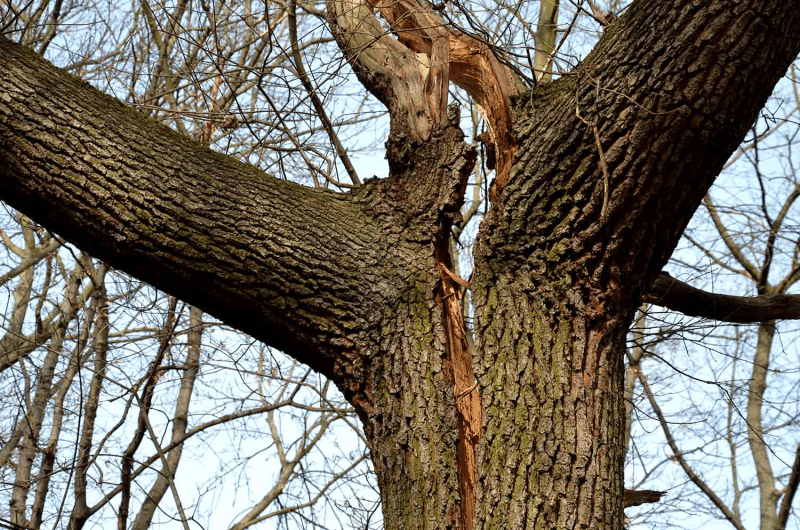
Sign 3. The Trunk Has Cracks, Splits, or Open Wounds
The trunk is the main support system of the tree. Cracks, deep splits, cavities, and large wounds can all indicate structural weakness or internal decay.
Warning signs of trunk damage include:
- Vertical cracks running through the trunk
- Splits where major limbs connect
- Large old wounds that never closed properly
- Hollow areas or cavities
- Bark peeling away from damaged sections
A cracked or hollow tree may keep standing while being unsafe. Once structural strength is compromised, the tree may be more likely to fail during high winds or heavy storms.
Sign 4. Mushrooms or Fungal Growth Are Appearing Near the Base
Mushrooms at the base of a tree can be more than a cosmetic issue. Fungal growth may indicate decay in the roots, trunk, or lower portion of the tree.
Root and trunk decay can weaken the tree from the inside out. By the time the canopy looks thin or the trunk begins to shift, the hidden damage may already be quite advanced.
It’s important to note that mushrooms alone don’t mean immediate removal is necessary, but they are a good reason to have the tree inspected, especially if you also notice thinning foliage, dead limbs, a new lean, or other coinciding signs of decline.
Sign 5. The Tree Drops Large Limbs During Normal Weather
It’s one thing for a tree to lose branches during a severe storm. It’s another altogether for large limbs to fall during calm and ordinary weather.
Repeated limb drop can point to structural weakness, decay, poor branch attachments, old storm damage, or just general decline. It also creates a clear safety concern, especially if limbs are falling near people, vehicles, walkways, or highly utilized outdoor spots.
If your tree has already dropped a large limb, don’t assume the rest are safe and secure. The same conditions that caused one to fall may be present elsewhere in the canopy.
Sign 6. The Tree Is Too Close to Homes, Roads, or Utility Lines
A tree becomes a bigger liability when it has a target. A declining tree in the far corner of a wooded lot is generally less urgent than a questionable tree hanging over a bedroom, driveway, sidewalk, road, or power line.
A tree may need professional attention if it is:
- Leaning toward a home or garage
- Growing over a driveway or parking area
- Crowding a sidewalk or street
- Rubbing against a roof or siding
- Interfering with utility lines
- Dropping limbs onto neighboring property
When the potential damage is high, it’s better to act early. Trimming, selective pruning, or preemptive tree removal may help reduce the risk before the tree causes property damage or blocks access.
Sign 7. The Canopy Looks Thin, Dead, or Uneven
A thinning canopy can be an early sign that the tree is under stress. Some trees decline slowly, losing branches a little at a time until the structural issues become more obvious.
Canopy decline can point to deeper problems:
- Sparse leaves compared to previous years
- Dead branches clustered on one side
- Bare branch tips
- Early leaf drop
- Sections of the canopy that never leaf out
- A tree that looks worse each season
Canopy decline may point to root stress, disease, pests, nutrient problems, construction damage, or other issues. But if canopy decline is combined with cracks, decay, leaning, or large dead limbs, the risk level may be higher.
When Is It an Emergency?
Some tree concerns can be scheduled for an estimate. Others need immediate attention from an emergency tree service.
Call for emergency tree service if the risk is immediate:
- A tree has fallen on a home, vehicle, fence, or driveway
- A large limb is hanging overhead
- A tree is leaning suddenly after a storm
- The trunk has split or cracked badly
- Roots are lifting and the tree is shifting
- A tree is blocking access to your property
- A tree or limb is near power lines
If power lines are involved, stay away from the area and contact the utility company first. Do not try to cut, pull, or move any tree or branch that may be touching electrical lines.

Get a Professional Opinion Before A Tree Falls
The safest time to deal with a risky tree is before it fails. A professional evaluation can help determine whether the tree needs trimming, monitoring, plant health care, or removal.
ProTree Services has Certified Arborists on staff who can evaluate tree conditions, identify potential risks, and give expert recommendations for your property.
Call ProTree Services for Tree Risk Concerns
If you’re seeing signs a tree is going to fall on your property, don’t wait for it to come down on its own. ProTree Services provides professional tree removal, trimming, emergency service, and Certified Arborist guidance for homeowners and property owners across Greater Philadelphia, including Chester County, Delaware County, and parts of Montgomery County, as well as Northern Delaware and parts of New Jersey.